Just Wayne. Just saying.

Month: March 2026

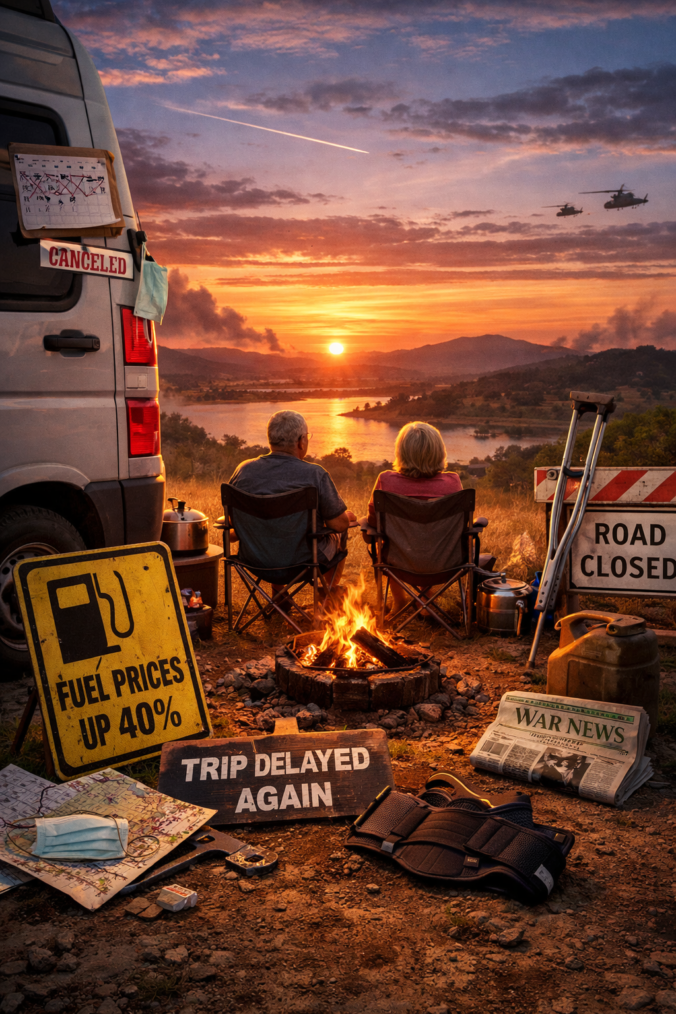
Whatever you do, don’t plan to travel with us.

There’s a running joke at our place at the moment — and like most good jokes, it’s only funny until you realise you’re the punchline.

Whatever you do, don’t plan to travel with us… or at the same time as us.

Every time we get close to heading off, something steps in. If it’s not COVID, it’s a bad back. If it’s not that, it’s car trouble — twice, just to make sure the lesson sticks. Then surgery. Then fuel shortages. And if all else fails, well… why not throw in a world war for good measure?
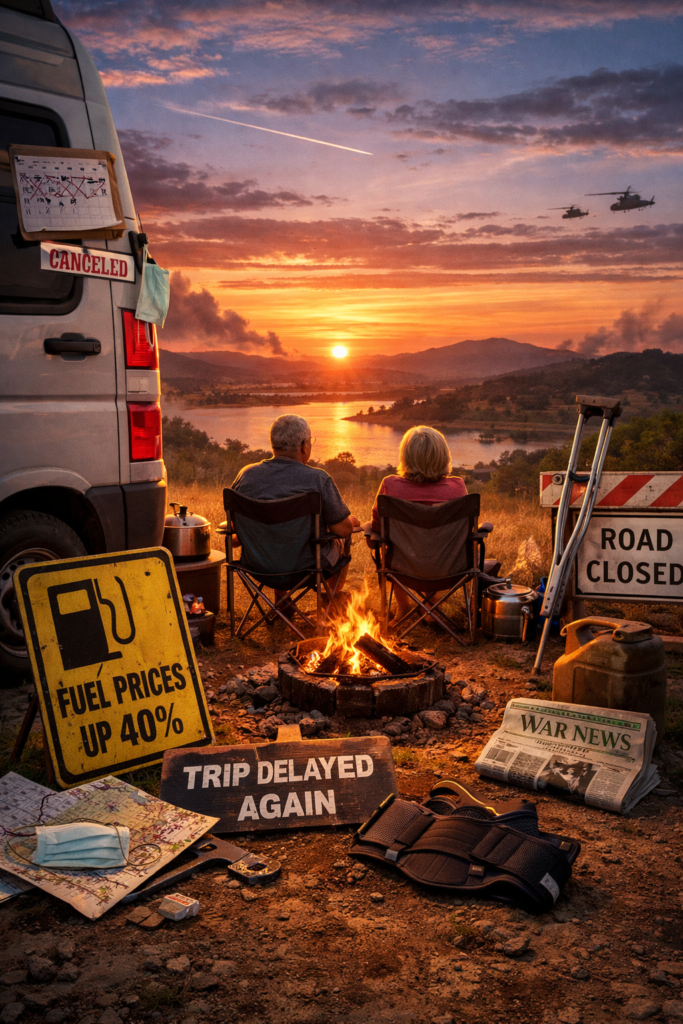
I know, I know — first world problems. There are far bigger issues in the world right now. But that doesn’t stop the frustration from creeping in when you’ve spent so long planning something, working toward it, and watching the start line keep shifting just out of reach.

We’re so close now we can almost taste it.

The plan — if you can still call it that — is to finally get out on the road in a couple of weeks. After all the delays, all the false starts, all the “maybe next month” conversations, it feels like this time it might actually happen.

And right on cue, as if the universe is staying true to form, fuel prices have just jumped by 40%.

As I write this, the government is meeting to decide whether fuel rationing might be needed. You couldn’t make it up if you tried.

Part of me just shakes my head and laughs. Not because it’s funny, but because at some point you either laugh or you go mad. It’s almost become expected — like there’s always going to be one more hurdle, one more reason to wait, one more excuse to stay put.

But at some point, you stop waiting for perfect.

Because perfect clearly isn’t coming.

Maybe fuel stays high. Maybe it doesn’t. Maybe plans change again — they probably will. But the whole point of this next chapter was never about perfect conditions. It was about getting out there, seeing the country, and finally doing something we’ve talked about for years.

So this time, we’re holding our nerve.

If we make it out in a couple of weeks, even if fuel is through the roof and the plan isn’t quite what we imagined, it’ll still be a win. A big one.

Because after everything that’s been thrown at us, just getting on the road will feel like breaking the streak.

And honestly, that first night camped somewhere quiet, away from all the noise and delays and what-ifs…

That might just make it all worth it.

If you agree with what you read, great. If you don’t, that’s fine too. This isn’t advice and it’s not instruction — it’s just one person thinking out loud and sharing the result. Let me know what you think by leaving a comment.

Just Wayne. Just saying.

Doomscrolling: The New Smoking?

It’s been on my mind lately that doomscrolling might be the modern equivalent of smoking.

Growing up in the 1960s and ’70s, cigarettes were everywhere. My parents smoked, people smoked on television, and tobacco companies advertised during sport like it was the most normal thing in the world. Lighting up was seen as calming, something to do with your hands, even—strangely—something that looked cool. I never quite understood the appeal, but it was impossible to ignore. It was part of the fabric of everyday life.

I remember when a close friend of mine, at just sixteen, decided to take up smoking. It changed things. He drifted away from our group of non-smoking mates, and looking back now, I sometimes wonder if I should have tried harder to talk him out of it. The truth is, I probably couldn’t have changed his mind. Smoking had a powerful pull back then—social, cultural, even aspirational.

Recently, that same friend passed away from a smoking-related illness. It’s one of those moments that quietly forces you to reflect on how something once so widely accepted can carry such a heavy cost.

Today, smoking is viewed very differently. The risks are well understood, public attitudes have shifted, and regulations have pushed it out of many shared spaces. What was once normal is now, rightly, seen as harmful.

But it makes me wonder—have we simply replaced one habit with another? And this time, it is one that I am finding myself tempted by.

Idle hands, that once might have been occupied by cigarettes, are now filled with smartphones. And instead of taking a drag, we scroll. Endlessly.

Doomscrolling—this compulsive habit of consuming negative news and social media—has crept into our lives so subtly that we barely question it. Like smoking once was, it’s everywhere. It fills quiet moments, distracts us when we’re bored, and gives the illusion of staying informed or connected.

But at what cost?

Physically, we’re starting to see the effects. “Tech neck” is becoming common, and younger generations are developing repetitive strain issues in their hands and thumbs from constant scrolling. These may sound minor, but they’re signals of a deeper shift in how we use our bodies.

More concerning, though, is the impact on mental health.

Constant exposure to triviality, bad news, comparison, and outrage chips away at our sense of wellbeing. It can heighten anxiety, distort our view of the world, and quietly erode self-esteem. Just as smokers once believed cigarettes helped them relax, many people now turn to their phones for comfort—only to come away feeling worse.

The jury is still out on its social impact. It seems to me that when two people are together but not actually engaging—because they’re both scrolling on their devices—it’s antisocial. They might argue the opposite, that they’re being social by engaging with multiple people at once, but I’m not convinced.

And like smoking in its heyday, doomscrolling is socially reinforced. Everyone is doing it. It’s normal. Expected, even.

That’s what makes it hard to challenge.

I’m not suggesting that scrolling your phone is the same as smoking a pack of cigarettes a day. But the pattern feels familiar: a widely accepted habit, woven into daily life, offering short-term relief while potentially causing long-term harm.

History has a way of repeating itself—just in different forms.

The difference now is that we’re still early enough to question it.

Maybe the answer isn’t to eliminate technology altogether, just as the solution to smoking wasn’t to eliminate stress or socialising. But awareness matters. Boundaries matter. Choosing when to engage—and when to put the phone down—might be one of the most important small decisions we make each day.

Because if doomscrolling really is the new smoking, it’s worth asking ourselves a simple question:

Do we want to wait decades to fully understand the damage—or start making changes now?

If you agree with what you read, great. If you don’t, that’s fine too. This isn’t advice and it’s not instruction — it’s just one person thinking out loud and sharing the result. Let me know what you think by leaving a comment.

Just Wayne. Just saying.

A Simpler Faith for the Road Ahead.

When I first became a Christian, I wanted to understand everything.

I read theology, studied the history of the Church, tried to learn the context of the Bible and the meaning behind the scriptures. I wanted to know what scholars thought, what different traditions believed, and how all the pieces fitted together. Like many new Christians, I assumed that the deeper my faith became, the more complicated it would become.

In some ways, that was true. The more you study, the more you realise that things are rarely as simple as they first appear. The Bible is ancient and layered. The Church has two thousand years of history, much of it inspiring, some of it troubling. Christians disagree about many things.

And eventually you come to a slightly uncomfortable realisation: the more we know, the more we realise how much we don’t know.

But something else has happened to me over the years.

In a strange way, faith has also become simpler.

After years of reading and thinking, I find myself returning to a single idea that sits at the heart of it all: God is love.

If something is done in love, it carries the mark of God.

If it is not done in love, then however religious it may sound, I struggle to see God in it.

(1 John 4:8)

That doesn’t mean love is easy. In fact, it may be the hardest calling of all. Love requires patience, humility, forgiveness, and compassion. It asks us to see other people not as enemies or problems to be solved, but as fellow human beings made in the image of God.

Over the years I have seen Christianity expressed in many different ways. Some of it has been thoughtful and gentle. Some of it has been loud and certain of itself. Some of it has been tied very closely to politics and power.

But the older I get, the more I find myself returning to the question: Where is the love in this?

If love is there—real love, not just words—then I feel confident that God is there too.

If it is absent, then no amount of religious language can quite convince me otherwise.

I am also increasingly aware that it is not my place to decide who is or isn’t a Christian. That judgement belongs to God alone. My task is much simpler, and perhaps much harder: to try, however imperfectly, to live a life shaped by love.

After all the books, all the debates, and all the years of thinking about faith, this is what seems to remain.

Faith is not really about winning arguments or proving that we are right.

It is about learning, slowly and imperfectly, how to love.

If you agree with what you read, great. If you don’t, that’s fine too. This isn’t advice and it’s not instruction — it’s just one person thinking out loud and sharing the result. Let me know what you think by leaving a comment.

Just Wayne. Just saying.

Life, Family, and a Symphony: Bec Somehow Does It All.

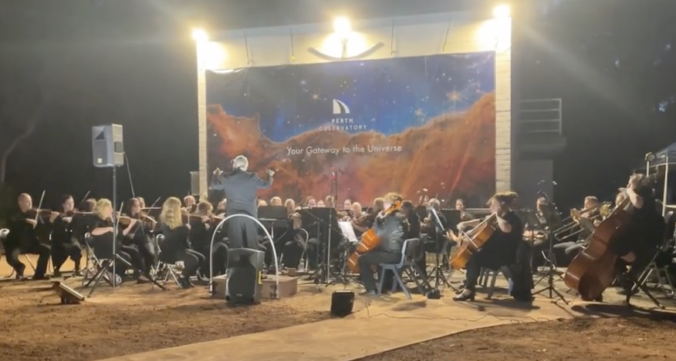
Watching Bec perform with the Hills Symphony Orchestra is breathtaking— though honestly, it’s hard to know where to start! She somehow manages to raise three beautiful children, keep a busy household running, hold down a full-time job, and still find the energy and passion to play at this incredible level. We are beyond proud of her—not just for her talent, but for the amazing person she is every single day. This video is a little window into the magic she brings to the stage.

Holding Onto Humanity in Dark Times

The world feels heavy right now. Headlines tell of children killed, leaders acting with apparent disregard for life, and conflicts that escalate faster than we can comprehend. It’s hard to breathe sometimes, let alone believe that hope is possible.

I won’t pretend it’s easy. I feel rage, grief, and disbelief alongside the quiet fear that tomorrow could bring something worse. And yet, even in the darkest times, there is something that remains within our control: our humanity.

Yes, technology can amplify destruction. Yes, politics and war machines make the consequences of mistakes catastrophic. But no algorithm, no missile, no government can take away our ability to choose empathy, conscience, and care. That is ours alone.

It’s tempting to feel powerless, to give in to despair—but small acts still matter. Speaking out against injustice. Protecting those who cannot protect themselves. Listening to the suffering of others. Standing up, even when it feels like no one else is. These choices may seem tiny, but they are the threads that hold a human society together.

Choosing humanity is a form of resistance. It reminds us—and everyone around us—that cruelty and indifference are not inevitable. They are decisions, and decisions can be challenged. We may not control the world, but we can control how we live in it, how we act, and how we respond to the suffering we see.

So, even when the world seems devoid of conscience, let us carry ours. Let us act with courage, kindness, and moral clarity. This is where hope lives—not in headlines, not in powerful offices, but in the human hearts that refuse to turn away.

Because as long as we do that, we are still human. And that, perhaps, is the most powerful thing we can be.

If you agree with what you read, great. If you don’t, that’s fine too. This isn’t advice and it’s not instruction — it’s just one person thinking out loud and sharing the result. Let me know what you think by leaving a comment.

Just Wayne. Just saying.
© 2026 Wayne's World

Theme by Anders NorenUp ↑